

#Semester I
#Module I: Human and Medicine
#Lesson 1: Medicine in antiquity
(Primitive Medicine, Nepalese medicine, Indian Medicine, Chinese Medicine, Egyptian Medicine, Greek Medicine, Roman Medicine)
#By the end of this session, learners will be able to:
Describe key features of primitive medicine.
Provide the contribution in Traditional Nepalese medicine
Explain principles of Indian (Ayurvedic) medicine.
Summarize contributions of Chinese medicine.
Identify medical practices in ancient Egypt.
Discuss Greek medicine and the theory of humors.
Outline Roman medical knowledge and public health practices.
#The basics of Medicine in Antiquity
Those who fail to read history are destined to suffer the repetition of its mistakes.
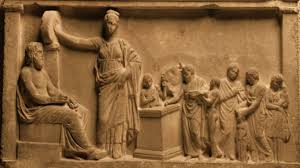
A sculpture of the Asclepius Cult. They are seeking help from their healing God, who is now represented in the symbol of the American Medical Association.
Medicine in antiquity refers to the study and practice of health, disease, and healing in ancient civilizations, deeply linked with religious, magical, and philosophical beliefs that shaped early human culture and science.
In ancient times, health and illness were understood in relation to the cosmos (universe) and human nature.
Medicine was dominated by magical and religious beliefs, closely tied to culture and rituals.
Henry Sigerist stated that every culture developed its own system of medicine, reflecting its cultural history.
Dubos described ancient medicine as the “mother of sciences”, contributing to the growth of early civilizations.
The development of medicine was linked to the progress of philosophy, religion, economy, government, education, and science of the time.
Here we learn about Primitive Medicine, Nepalese medicine, Indian Medicine, Chinese Medicine, Egyptian Medicine, Greek Medicine, Roman Medicine
#Primitive Medicine
#Primitive medicine refers to the earliest form of healing practices in human history, based on superstition, religion, magic, and the supernatural theory of disease, rather than scientific understanding.
#🤝 Origin of Medicine
Medicine began from sympathy and necessity — early humans cared for the sick and tried to relieve suffering.
The first doctor was the first person who tried to heal others.
#🌩️ Supernatural Theory of Disease
Primitive people believed diseases were caused by angry gods, evil spirits, or stars and planets.
Illness was seen as a punishment or curse.
#🕯️ Methods of Healing
Treatment included prayers, sacrifices, rituals, witchcraft, and use of charms, amulets, and herbs to protect against spirits.
#⛏️ Early Surgical Practices
Prehistoric humans used stone and flint tools for simple procedures such as circumcision, amputation, and trephining (skull surgery).
#🌍 Survival of Primitive Beliefs
Elements of primitive medicine still exist today in many regions of Asia, Africa, and South America, where people still use mantras, faith healing, or link disease to sin or curse.
#🧙♂️ Traditional Healers
The modern-day traditional healers or shamans continue these practices, blending religion, magic, and empirical methods to treat illness.
#Nepalese Medicine
Nepalese medicine refers to the traditional healing systems and medical practices that evolved in Nepal, blending Ayurveda, Tibetan medicine (Amchi system), and local folk healing traditions, influenced by both Indian and Tibetan cultures.
#📚 Main Systems
🌿 1. Ayurveda
🕰️ Introduced through cultural exchange with India, flourishing during the Licchavi and Malla periods.
⚖️ Emphasizes the Tridosha theory (Vata, Pitta, Kapha).
🌱 Uses natural remedies derived from Himalayan herbs.
🏘️ Still widely practiced in both rural and urban settings.
🕉️ 2. Amchi (Tibetan Traditional Medicine)
🏔️ Practised among Tibetan and Himalayan communities (e.g., Mustang, Dolpa, Humla).
🪷 Integrates Buddhist philosophy, astrology, and herbal–mineral medicine.
⚖️ Focuses on the balance of three energies: wind, bile, and phlegm.
✋ Diagnosis involves pulse reading, urine examination, and holistic patient history.
🔮 3. Folk Healing / Shamanism
👥 Practised by Jhankri, Pujari, Dhami, Guruwa, and other spiritual healers.
🕯️ Emphasizes rituals, chanting, spiritual possession, and use of local medicinal plants.
🏞️ Plays a major role in rural health care, especially where biomedical services are limited.
#🕉️ Historical Development
🪶 Pre-Licchavi Period (Before 400 A.D.)
🗣️ Indigenous healing traditions existed — mostly oral and ritualistic.
🌿 Knowledge of herbs and natural resources was widespread in communities.
🏛️ Licchavi Period (400–750 A.D.)
🌺 Ayurvedic medicine flourished under state patronage.
📜 Sanskrit medical manuscripts and inscriptions indicate organized health systems.
👑 Malla Period (1200–1768 A.D.)
🏥 Establishment of Baidya Khana (dispensaries) for public healthcare.
👨⚕️ Ayurvedic physicians served in royal courts and among the general public.
🏰 Shah and Rana Periods
🌿 Continued support for Ayurveda; Singha Durbar Baidhyakhana became a central dispensary.
🌍 Introduction of some Western medical practices, but traditional medicine remained dominant.
🧭 Modern Period
🎓 Formal Ayurvedic education began under Tribhuvan University.
🏔️ Amchi schools established to preserve Tibetan medical knowledge.
🩺 Integration of traditional and modern health systems under Nepal’s Ministry of Health.
#👨⚕️ Notable Institutions and Figures
🏥 Singh Durbar Baidhyakhana Vikas Samiti (Revived 1960 A.D.)
💊 Produces classical Ayurvedic medicines.
🩺 Provides treatment services to the public.
🏛️ One of Nepal’s oldest state-supported Ayurvedic institutions.
🎓 Institute of Ayurvedic Medicine (IOM, Tribhuvan University)
📚 Offers BAMS (Bachelor of Ayurvedic Medicine and Surgery) and postgraduate training.
🌿 Promotes research and formal education in Ayurveda.
🧑⚕️ Plays a key role in integrating Ayurveda into the national health system.
🏔️ Amchi Schools (e.g., Lo Kunphen Medical School, Mustang)
📖 Train Amchis using Tibetan medical texts and traditional apprenticeship.
🌱 Focus on preservation and transmission of indigenous Tibetan medical knowledge.
👑 Royal Vaidhyas and Court Physicians
🧍♂️ Served as early organized health providers in royal courts.
🏛️ Played a crucial role in maintaining public health before the advent of modern medical systems.
#🌟 Modern Pioneers
✍️ Contributed to the standardization of Ayurvedic education.
🩺 Advocated for the integration of traditional medicine into national health policies and curricula.
🧠 Worked to modernize production, regulation, and education in traditional systems.
#Indian Medicine
Indian medicine refers to the traditional systems of healing that developed in ancient India, mainly Ayurveda and Siddha, which combined spiritual, philosophical, and empirical knowledge of health and disease.
#📚 Main Systems
Ayurveda (practised throughout India) and Siddha (South India, Tamil regions) are indigenous systems.
Both share similar theories and practices focusing on balance and natural healing.
#🕉️ Origins and Meaning
Ayurveda means “knowledge of life,” tracing back to Vedic times (~5000 B.C.).
Medical ideas evolved from the Atharvaveda and were linked with Hindu mythology (e.g., Dhanvantari, the god of medicine).
#👨⚕️ Great Indian Physicians
Atreya (800 B.C.) – Early teacher of medicine at Takshashila.
Charaka (200 A.D.) – Compiled Charaka Samhita, based on Atreya’s teachings; described 500 drugs including Rauwolfia serpentina (for hypertension).
Sushruta (800 B.C.–400 A.D.) – Known as the “Father of Indian Surgery”; compiled Sushruta Samhita on surgery, anatomy, pathology, midwifery, hygiene, and plastic surgery.
#💉 Medical and Surgical Achievements
Early Indians performed fracture setting, amputations, cataract and hernia operations, and rhinoplasty (nose repair).
British surgeons later learned plastic surgery techniques from Indian practitioners.
#☸️ Tridosha Theory of Disease
Health depends on balance of three doshas:
Vata (wind)
Pitta (bile/gall)
Kapha (phlegm)
Imbalance leads to disease — similar to the Greek four-humor theory.
#🏥 Public Health and Hygiene
Laws of Manu emphasized personal hygiene.
Excavations at Mohenjo-Daro and Harappa show advanced sanitation and drainage systems.
#🕰️ Golden Age and Decline
Golden age: 800 B.C.–600 A.D., supported by Buddhist rulers like Ashoka.
Declined during Mughal and British periods due to reduced state support.
#🌐 Influence Beyond India
Indian medicine spread to Tibet, Central Asia, China, Indonesia, and Japan, similar to how Greek medicine spread in the West.
#🧴 Other Systems in India
Unani-Tibb – Introduced by Muslim rulers (10th century A.D.), based on Greek medicine.
Homoeopathy – Introduced by Samuel Hahnemann (1755–1843); based on “like cures like.”
India today has the largest number of homoeopathic practitioners in the world.
#🌿 Present Relevance
Ayurveda, Siddha, Unani, and Homoeopathy remain vibrant parts of Indian culture.
They continue to provide accessible healthcare, especially in rural areas.
#Chinese Medicine
Chinese medicine is one of the oldest organized medical systems (dating back to 2700 B.C.) based on the balance between yin and yang, emphasizing harmony, prevention, and holistic healing.
#🧘♂️ Philosophical Foundation
Based on two opposite forces:
Yang – active, masculine, positive principle
Yin – passive, feminine, negative principle
Health = balance of yin and yang; disease = imbalance.
#🌿 Holistic Treatment Methods
Included hygiene, dietetics, hydrotherapy, massage, and herbal medicine.
Focused on maintaining balance through natural and preventive approaches.
#💉 Early Immunization
Chinese physicians were pioneers of variolation (early smallpox prevention), centuries before modern vaccination.
#🩺 Preventive Philosophy
The ideal physician was one who prevented illness before it occurred — reflecting the preventive spirit of Chinese medicine.
#⚕️ Integration and Modern Influence
Traditional medicine remains deeply respected and integrated with modern healthcare in China.
Practices like acupuncture and the “barefoot doctor” system gained global recognition for community-based healthcare.
#Egyptian Medicine
Egyptian medicine refers to the medical practices of ancient Egypt (around 2000–1150 B.C.), where medicine, religion, and magic were closely linked. Physicians were often priests, trained in temple schools, and healthcare was strongly influenced by spiritual beliefs.
#🏛️ Religion and Medicine
Medicine in ancient Egypt was deeply connected with religion.
Physicians were commonly priests trained in temple schools, and patients were treated within temples, which were regarded as centers of healing. Healing rituals often combined medical treatment with prayers and magic.
#👨⚕️ Imhotep – The First Physician
Imhotep (2800 B.C.) was Egypt’s most famous physician, as well as an architect and statesman.
He was later worshipped as a god of medicine.
Medical specialization existed, including eye doctors, head doctors, and dentists.
Physicians were paid by the State, indicating an organized healthcare system.
#📜 Medical Texts and Records
Egyptians preserved medical knowledge through papyrus scrolls.
The Edwin Smith Papyrus (3000–2500 B.C.) is the earliest known surgical text and contains descriptions of head injuries, fractures, and paralysis.
The Ebers Papyrus (1150 B.C.) listed around 800 prescriptions using more than 700 drugs, including castor oil, opium, senna, and various minerals.
#💊 Medical Beliefs and Practices
Disease was believed to originate from intestinal toxins that caused impurity of the blood.
Common treatments included:
Cathartics and enemas
Bloodletting
Herbal and mineral drugs
Egyptians also recognized the pulse as the “speech of the heart.”
#🧫 Public Health Achievements
Ancient Egyptians demonstrated advanced public health practices.
They built planned cities, public baths, and underground drainage systems, reflecting an understanding of sanitation.
They practiced smallpox inoculation, used mosquito nets, and associated plague with rats.
Horus, the god of health, was widely worshipped.
#⏳ Legacy
Egyptian medicine flourished for nearly 2,500 years and had a strong influence on later civilizations.
Over time, it was replaced by Greek medicine as the dominant medical tradition, but its contributions remain foundational in medical history.
#Mesopotamian Medicine
Mesopotamian medicine refers to the medical practices of ancient Mesopotamia (around 2100–2000 B.C.), where religion, magic, and law governed healthcare. Medical practice was closely supervised by the state, and physicians were required to follow strict legal codes.
#🏺 Religion and Magic in Medicine
Medicine in Mesopotamia was deeply intertwined with religion and magic.
Practitioners were classified into different types, including herb doctors, knife doctors, and spell doctors, comparable to modern internists, surgeons, and psychiatrists.
Disease was commonly believed to be caused by demons, evil spirits, or supernatural forces.
#🔮 Medical Practices and Divination
Various forms of divination were used to diagnose and predict disease outcomes.
These included geomancy, dream interpretation, and hepatoscopy, the examination of the liver, which was considered the seat of life.
Mesopotamians also developed medical astrology, which later influenced medical practices across Eurasia.
Medical prescriptions were recorded in cuneiform script on clay tablets.
#📜 Oldest Medical Prescriptions
The earliest recorded medical prescription dates back to 2100 B.C.
Clay tablets described treatments for different illnesses, often combining herbal remedies, rituals, incantations, and charms.
#⚖️ Code of Hammurabi
King Hammurabi (c. 2000 B.C.) introduced a set of laws that regulated medical practice.
The code specified fees for medical services and strict penalties for malpractice, including death for unsuccessful treatment in certain cases.
This code represents the first known legal framework governing medical practice.
#🧫 Scientific Basis
Despite its legal organization, Mesopotamian medicine lacked a scientific foundation.
Most treatments were ritualistic and superstitious, with limited reliance on observation or evidence.
#Greek Medicine
Greek medicine (460–136 B.C.) laid the foundation of scientific medicine. It emphasized observation, reasoning, ethics, and balance in health, and marked a major transition from supernatural explanations to natural causes of disease.
#🏛️ Origins and Early Figures
Greek medicine traces its origins to Aesculapius (c. 1200 B.C.), the god of healing.
His daughters Hygiea, representing prevention, and Panacea, representing cure, symbolized the division between preventive and curative medicine—a concept that remains relevant today.
The staff of Aesculapius, a rod entwined with a serpent, continues to serve as the symbol of medicine.
#👨⚕️ Hippocrates – Father of Medicine
Hippocrates (460–370 B.C.) is regarded as the Father of Medicine.
He introduced clinical observation and logical reasoning into medical practice and rejected magical and religious explanations of disease.
He is credited with the Hippocratic Corpus, consisting of 72 volumes, which represents the first organized collection of medical literature.
The Hippocratic Oath established enduring principles of medical ethics and professional integrity.
#🌍 Hippocrates as Epidemiologist
Hippocrates made important contributions to epidemiology.
He distinguished between epidemic and endemic diseases and studied the influence of climate, water, diet, and lifestyle on health.
His work “Airs, Waters, and Places” is considered one of the earliest texts on social and environmental medicine.
#⚖️ Humoral Theory of Health and Disease
Greek medicine proposed that health depended on the balance of four humors:
Blood
Phlegm
Yellow bile
Black bile
Disease was believed to result from an imbalance of these humors.
Although scientifically outdated, this theory introduced the important concept of the body’s natural tendency toward self-healing.
#🧠 Legacy and Influence
Greek medicine established the scientific approach to medical practice.
The School of Alexandria (300–30 B.C.) emerged as the world’s first medical university, continuing Hippocratic traditions.
Greek medical philosophy profoundly influenced Roman, Arab, and modern medicine, shaping healthcare for centuries.
#Roman Medicine
Roman medicine (1st century B.C.–5th century A.D.) was a practical, prevention-focused system. While it adopted much of Greek medical theory, Roman medicine emphasized sanitation, public health, and organized healthcare services.
#🧩 Greek Influence
Roman medical knowledge was heavily influenced by Greek medicine, particularly the teachings of Hippocrates.
Although political power shifted to Rome, medical theory largely remained Greek, and many Greek physicians practiced in Roman society.
#🧱 Public Health and Sanitation
Romans were pioneers in public health infrastructure.
They constructed public baths, aqueducts, sewers, and hospitals, drained marshes to reduce malaria, and ensured a clean and continuous water supply to urban populations.
These measures greatly improved population health and disease prevention.
#🧠 Galen – The Great Roman Physician
Galen (130–205 A.D.), born in Pergamon, served as the personal physician to Emperor Marcus Aurelius.
He made major contributions to comparative anatomy and experimental physiology.
Galen’s work combined clinical observation, animal dissection, and logical reasoning, establishing him as the most influential physician of ancient Rome.
#⚖️ Concepts of Health and Disease
Galen emphasized the importance of prevention, stating:
“Health precedes disease; first preserve health, then cure disease.”
He identified three causes of disease:
Predisposing factors – internal susceptibility
Exciting factors – immediate causes
Environmental factors – external influences
These ideas closely resemble modern epidemiological concepts.
#📚 Legacy and Influence
Galen authored over 500 medical treatises, shaping European medical practice for nearly 1,400 years.
His teachings dominated medicine until they were challenged by Vesalius (1543) in anatomy and William Harvey (1628) in the study of blood circulation.
Roman medical achievements laid the foundation for modern public health systems.
==============================================================
#Middle Ages (500–1500 A.D.)
The Middle Ages, often called the “Dark Ages of Medicine”, marked a period of decline in European medical knowledge following the fall of the Roman Empire. While superstition and religious dogma dominated Europe, Arab scholars preserved and advanced medical science through the Unani system, major advances in pharmacology, and organized hospital care.
#🕯️ Decline of Western Medicine
After the collapse of the Roman Empire, organized medical schools disappeared.
Europe experienced repeated outbreaks of plague, leprosy, tuberculosis, and smallpox.
Human dissection was banned, bathing was considered immoral, and superstition replaced scientific reasoning in medical practice.
#📚 The “Dark Ages” of Medicine
Medical progress stagnated due to religious dogma and lack of scientific inquiry.
The emphasis shifted from physical health to spiritual salvation, limiting the development of medical knowledge.
The term “Dark Ages” reflects this prolonged period of regression and stagnation in medicine.
#🌙 Rise of Arabic Medicine
While Europe declined, Arabic scholars preserved and expanded Greek and Roman medical knowledge.
They developed the Unani system of medicine and established medical schools and hospitals in cities such as Baghdad, Damascus, and Cairo.
Their efforts ensured the survival of classical medical knowledge until it was later reintroduced to Europe.
#👨⚕️ Notable Arab Physicians
Rhazes (Abu Becr, 865–925 A.D.)
First to clearly distinguish smallpox and measles
Used mercurial purgatives
Studied eye reactions to light
Avicenna (Ibn Sina, 980–1037 A.D.)
Author of “Canon of Medicine”, a 21-volume medical encyclopedia
Influenced both Islamic and European medicine for centuries
Their achievements marked the Golden Age of Arabic Medicine (800–1300 A.D.).
#🏥 Hospitals and Monasteries
Christian teachings encouraged charitable care for the sick.
The first hospital in England was established in York in 937 A.D.
Hospitals in Baghdad and Cairo featured separate wards, libraries, music therapy, and fountains to cool patients with fever.
Monasteries also became centers of healing and nursing, preserving ancient medical texts and providing care to the poor.