
#Disease Classification
Parajuli SB, 2026
www.suryaparajuli.com.np
For
Community Medicine (Kathmandu University) | MBBS 1st Semester | Batch 2026
Birat Medical College Teaching Hospital
April 21, 2026 | 12:00 PM – 1:00 PM NST
#Specific Learning Outcomes (SLOs)
At the end of the session, the learner will be able to
describe the classification of diseases and explain its importance
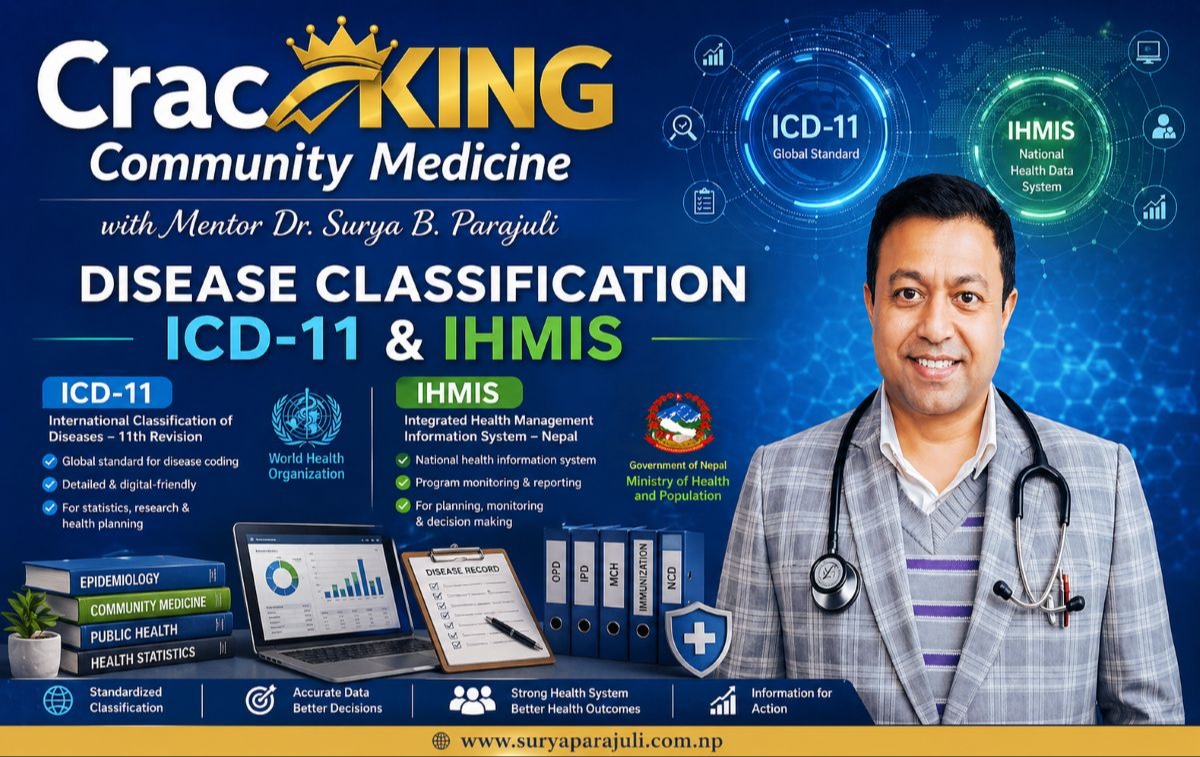
explain the International Classification of Diseases — ICD-11
describe the Integrated Health Information Management System — IHIMS
apply disease classification and health information systems
#Disease Classification
#Definition
Systematic grouping of diseases and health conditions into categories based on:
Cause (etiology)
Symptoms and clinical features
Body systems affected
Severity and course
Helps in standardizing diagnosis, recording, and reporting of diseases
#Importance
Standardization of disease recording
Improves communication among health professionals
Supports data collection & reporting (IHIMS)
Useful in epidemiology (disease patterns & trends)
Guides planning and policy-making for resource allocation
#Major Classification Systems
ICD-11
DSM-5
SNOMED CT
ICPC-2
ICF
ATC/DDD
LOINC
CPT
MeSH
IHIMS Nepal
https://icd.who.int/en/
https://www.youtube.com/watch?v=jPW0sahWWg0
#ICD-11
#Overview
ICD-11 is the 11th revision of the International Classification of Diseases
Replaces ICD-10 as the global standard for:
Recording health information
Causes of death
#Development & Adoption
Developed by World Health Organization
Development started: 2007
Endorsed: 72nd World Health Assembly (25 May 2019)
Implementation date: 1 January 2022
#Structure
Large ontology with ~85,000 entities (classes/nodes)
Each entity represents:
Diseases
Pathogens
Symptoms
Developmental anomalies
External causes of injury/death
Social circumstances
Reasons for health service contact
#ICD-11 Family
Part of the WHO Family of International Classifications (WHO-FIC)
Main derivative:
ICD-11 MMS (Mortality and Morbidity Statistics)
Commonly referred to as “ICD-11”
#ICD-11 Chapters (All Chapters in One Table)
S.N. | RANGE | CHAPTERS |
|---|---|---|
1 | 1A00-1H0Z | Certain infectious or parasitic diseases |
2 | 2A00-2F9Z | Neoplasms |
3 | 3A00-3C0Z | Diseases of the blood or blood-forming organs |
4 | 4A00-B4BZ | Diseases of the immune system |
5 | 5A00-5D46 | Endocrine, nutritional or metabolic diseases |
6 | 6A00-6E8Z | Mental, behavioural or neurodevelopmental disorders |
7 | 7A00-7B2Z | Sleep-wake disorders |
8 | 8A00-8AE7Z | Diseases of the nervous system |
9 | 9A00-9AE1Z | Diseases of the visual system |
10 | AA00-AAC0Z | Diseases of the ear or mastoid process |
11 | BA00-BE2Z | Diseases of the circulatory system |
12 | CA00-CB7Z | Diseases of the respiratory system |
13 | DA00-DE2Z | Diseases of the digestive system |
14 | EA00-EM0Z | Diseases of the skin |
15 | FA00-FC0Z | Diseases of the musculoskeletal system or connective tissue |
16 | GA00-GC8Z | Diseases of the genitourinary system |
17 | HA00-HA8Z | Conditions related to sexual health |
18 | JA00-JB6Z | Pregnancy, childbirth or the puerperium |
19 | KA00-KD5Z | Certain conditions originating in the perinatal period |
20 | LA00-LD9Z | Developmental anomalies |
21 | MA00-MH2Y | Symptoms, signs or clinical findings, not elsewhere classified |
22 | NA00-NF2Z | Injury, poisoning or certain other consequences of external causes |
23 | PA00-PL2Z | External causes of morbidity or mortality |
24 | QA00-QF4Z | Factors influencing health status or contact with health services |
25 | RA00-RA26 | Codes for special purposes |
26 | SA00-SJ3Z | Supplementary Chapter Traditional Medicine Conditions - Module I |
27 | VA00-VC50 | Supplementary section for functioning assessment |
28 | XA0060-XY9U | Extension Codes |
Unlike the ICD-10 codes, the ICD-11 MMS codes never contain the letters I or O, to prevent confusion with the numbers 1 and 0
#Purpose of ICD-11
Standardizes diagnosis and disease reporting globally
Supports monitoring of disease trends and outbreaks
Helps in national and international health policy formulation
Facilitates uniform data for research studies
Improves clinical documentation and reimbursement systems
#Key Features of ICD-11
#1. Fully Digital System
First ICD version designed for electronic use
Available online with coding tools
Easy search, update, and real-time use
#2. Updated & Expanded Content
~17,000 diagnostic categories
Over 100,000 possible codes with combinations
Includes new diseases and conditions (e.g., Gaming disorder)
#3. User-Friendly Coding
Uses alphanumeric codes
Improved structure for easy searching
Faster and more intuitive coding system
#4. Clinical Detail
More detailed than ICD-10
Better classification of modern diseases
Includes emerging conditions
#5. International Standard
Used globally for mortality & morbidity data
Ensures uniform health statistics worldwide
#6. Coding System
Alphanumeric format (e.g., 1A00)
Each code represents a specific disease/condition
Supports combination (post-coordination) coding for higher detail
#IHIMS
(Integrated Health Information Management System)
Nepal’s national digital health platform integrating multiple health information systems into one unified framework.
Implemented by: Ministry of Health and Population, Nepal
Managed by: Department of Health Services
Purpose: Strengthen evidence-based decision-making at all levels of healthcare
Established: 1994/95 AD (2051/52 BS)
Roadmap Approved: IHIMS Roadmap 2022–2030 approved in 2021 AD (2078 BS)
#HMIS
(Health Management Information System)
Core component of IHIMS
Collects routine health service data
Covers:
OPD (Outpatient Department)
IPD (Inpatient Department)
Maternal and Child Health
Family Planning
Immunization
Nutrition Services
#Indicators Collected
Maternal Health – ANC visits, institutional delivery
Child Health – Immunization, malnutrition
Communicable Diseases – TB, malaria, HIV
Non-Communicable Diseases – Hypertension, diabetes
Service Utilization – OPD/IPD attendance
#Data Analysis and Use
Data analyzed at:
Facility level
Local government level
Provincial and central levels
#Used For
Planning health programs
Monitoring performance
Resource allocation
Policy formulation
#Advantages of IHIMS
Integration – Combines multiple systems into one unified platform
Real-Time Data – Faster reporting and quick decision-making
Improved Data Quality – Standardized formats and validation checks
Better Monitoring – Tracks national health programs effectively
Transparency – Accessible dashboards and reports
#MASTER LIST — HMIS Tool Groups 1 to 9
Group No. | HMIS Tool Group | Main Function | Service Area |
|---|---|---|---|
1 | Common Tools | Patient registration & basic services | General services |
2 | Infant & Child Health | Child health & immunization | Child health |
3 | Family Health | Maternal & reproductive health | RMNCAH |
4 | Community Services | Outreach & preventive programs | Community health |
5 | Disease Programs | Malaria, Leprosy, Kala-azar etc. | Communicable diseases |
6 | Tuberculosis | TB control & monitoring | TB program |
7 | HIV/AIDS & STI | HIV/STI services | HIV program |
8 | Hospital Services | Inpatient & emergency services | Hospital care |
9 | Monthly Reporting Forms | Monthly summary reporting | Reporting system |
#Detailed Compilation
#GROUP 1 — Common Tools
Purpose: Core patient registration and service documentation.
Major Forms:
HMIS 1.1 — Master Register
HMIS 1.2 — Health Service Card
HMIS 1.3 — OPD Register
HMIS 1.4 — Referral/Transfer Slip
HMIS 1.5 — Loss to Follow-Up
HMIS 1.6 — Open Tally Sheet
HMIS 1.7 — Basic Health Facility Monitoring Sheet
HMIS 1.8 — Hospital Monitoring Sheet
Key Role:
Foundation of all routine data collection.
#GROUP 2 — Infant and Child Health
Purpose: Child health monitoring.
Major Forms:
HMIS 2.1 — Child Health Card
HMIS 2.2 — Immunization Register
HMIS 2.3 — Nutrition Register
HMIS 2.4 — IMNCI Register
HMIS 2.5 — IMAM Child Health Card
HMIS 2.6 — IMAM Register
HMIS 2.7 — IMAM Hospital Register
HMIS 2.8 — NRH Register
Key Role:
Supports child survival indicators.
#GROUP 3 — Family Health
Purpose: Reproductive and maternal health services.
Major Areas:
Family Planning
Maternal Health
Newborn Health
Safe Abortion
RH Morbidity
Key Role:
Essential for maternal mortality reduction programs.
#GROUP 4 — Community Services
Purpose: Community outreach recording.
Major Forms:
Outreach Clinic Register
FCHV Register
Vitamin A Register
Health Promotion Register
Key Role:
Tracks preventive services at community level.
#GROUP 5 — Disease Programs
Purpose: Disease-specific services.
Major Programs Covered:
Malaria
Leprosy
Kala-azar
NCD
Mental Health
Key Role:
Supports disease elimination programs.
#GROUP 6 — Tuberculosis
Purpose: TB program management.
Major Forms:
Presumptive TB Register
Laboratory Register
Treatment Register
Contact Investigation Register
Key Role:
Essential for DOTS strategy monitoring.
#GROUP 7 — HIV/AIDS & STI
Purpose: HIV program documentation.
Major Forms:
HIV Testing Register
ART Register
PMTCT Register
STI Register
Key Role:
Supports national HIV surveillance.
#GROUP 8 — Hospital Services
Purpose: Hospital-level services.
Major Forms:
Admission Register
Discharge Register
Emergency Register
ICU/NICU Register
Key Role:
Provides hospital utilization statistics.
#GROUP 9 — Monthly Reporting Forms
This is the missing group you asked to compile.
Purpose: Monthly reporting and data submission.
Major Forms:
HMIS Code | Form Name |
|---|---|
HMIS 9.1 | FCHV Programme Report Collection & Reporting Form |
HMIS 9.2 | PHC-ORC Reporting Form |
HMIS 9.3 | Basic Health Facility Monthly Reporting Form |
HMIS 9.4 | Public Hospital Monthly Reporting Form |
HMIS 9.5 | Non-Public Health Facility Monthly Reporting Form |
These tools are used to submit monthly service data from facilities to higher administrative levels.
#HMIS Workflow Integration )
This is how all 9 groups function together:
Group 1–8 → Data Recording
Group 9 → Monthly Reporting
So the system works as:
Service → Recording → Reporting → Analysis → Planning
This is the core RHIS cycle.
#Integrated Functional Mapping
Function | HMIS Groups Involved |
|---|---|
Patient Registration | Group 1 |
Child Health | Group 2 |
Maternal Health | Group 3 |
Community Programs | Group 4 |
Disease Control | Group 5–7 |
Hospital Care | Group 8 |
Monthly Reporting | Group 9 |
#References
World Health Organization. International classification of diseases for mortality and morbidity statistics (11th Revision) (ICD-11) [Internet]. Geneva: WHO; 2019 [cited 2026 Apr 6]. Available from: https://icd.who.int
American Psychiatric Association. Diagnostic and statistical manual of mental disorders (DSM-5). 5th ed. Washington, DC: American Psychiatric Publishing; 2013.
American Psychiatric Association. Diagnostic and statistical manual of mental disorders (DSM-5-TR). 5th ed., text rev. Washington, DC: American Psychiatric Publishing; 2022.
World Health Organization. Health information systems: toolkit on monitoring health systems strengthening [Internet]. Geneva: WHO; 2008 [cited 2026 Apr 6]. Available from: https://www.who.int
Ministry of Health and Population (Nepal). Integrated Health Information Management System (IHIMS) guidelines [Internet]. Kathmandu: MOHP; [cited 2026 Apr 6]. Available from: https://mohp.gov.np
Ministry of Health and Population (Nepal). Annual Report, Department of Health Services (DoHS) [Internet]. Kathmandu: DoHS; [cited 2026 Apr 6]. Available from: https://dohs.gov.np
Park K. Park’s textbook of preventive and social medicine. 27th ed. Jabalpur: Banarsidas Bhanot; 2023.
World Health Organization. Classification of diseases (ICD) [Internet]. Geneva: WHO; [cited 2026 Apr 6]. Available from: https://www.who.int/standards/classifications