
Community Medicine Exam Tips: How to Prepare & Succeed?
#TIPS 1: 5-Star Success Points ⭐⭐⭐⭐⭐
1. Think like a Community Medicine professional
Always write answers as if you are approaching the problem from a public health and community perspective, not only clinical.
2. Use clear, simple language, but stay professional
Writing in “general people language” is good for clarity, but it does not replace accurate, guideline-based content expected in Community Medicine.
3. Write appropriate and precise answers
Include relevant points, steps, or classifications, but avoid writing unnecessary or overly lengthy (“lethal”) information that wastes time or confuses examiners.
4. Follow authentic guidelines and policies
Do not create your own national guidelines or programs. Always refer to WHO recommendations, CB-IMNCI, and Nepal-specific policies when asked.
5. Trust your knowledge and thinking
Before writing, pause and ask your mind for the correct, logical, and guideline-based answer. Avoid guessing or adding irrelevant content.
#TIPS 2: How to Solve MCQs (with Example)
#MCQ
Study design best for testing the hypothesis of rare diseases is:
A. Cross-sectional study
B. Case-control study ✅
C. Cohort study
D. Randomized clinical trial
#Step-by-Step MCQ Solving Strategy
Step 1: Identify the KEY WORD
👉 “Rare diseases”
This is the most important clue in the question.
Step 2: Recall the RULE
Rare disease → Case–control study
Rare exposure → Cohort study
Step 3: Eliminate Incorrect Options
❌ Cross-sectional study
→ Measures prevalence, not ideal for hypothesis testing❌ Cohort study
→ Requires large sample size for rare diseases❌ Randomized clinical trial
→ Not ethical or feasible for disease occurrence
✅ Correct Answer
Case-control study
#TIPS 3: How to Solve SAQ?
Enlist different epidemiological studies. Write the steps of case control study. (2+3)
👉 Golden rule:
Write in headings + bullet points + exact number of points asked
(Examiners give marks per point, not per paragraph.)
#Q1. Enlist different epidemiological studies (2 marks)
Epidemiological Studies
Descriptive studies
Case report
Case series
Cross-sectional study
Analytical studies
Case–control study
Cohort study
Experimental (Interventional) studies
Randomized controlled trial (RCT)
Field trial
Community trial
#Q2. Write the steps of Case–Control Study (3 marks)
Steps of Case–Control Study
Selection of cases
Identify individuals with the diseaseSelection of controls
Select comparable individuals without the diseaseAssessment of exposure
Determine past exposure in both cases and controlsAnalysis & interpretation
Compare exposure using Odds Ratio (OR)
#TIPS 4: How to Solve PBQ?
(1Q × 10 = 10 marks)
#Problem – I
A 20-year-old male came to the PHC in Budhiganga rural municipality with a history of dog bite the previous day. He reported that the stray dog was seen frequently in the locality. On examination, the bite was seen on the left leg with tears on the clothing. There was some bleeding seen as well. His general condition was fair although he appeared apprehensive.
a. Describe the WHO-recommended post-exposure prophylaxis for this young male. (3)
b. Describe why modern cell culture rabies vaccines are preferred rather than nerve tissue vaccines. (2)
c. Mention the advantages of intradermal rabies vaccination. (2)
d. Elaborate the role of the “One Health approach” in the prevention and control of Rabies. (3)
#TIPS 4: How to Solve PBQs (Problem-Based Questions)
(1 Question × 10 marks = 10 marks)
👉 Golden Strategy for PBQs
Read the problem carefully – underline clues (dog bite, bleeding, stray dog, rural PHC)
Identify the diagnosis/risk – here: Suspected Rabies exposure
Link answer strictly to sub-questions (a–d)
Write point-wise, guideline-based answers
Allocate time & content according to marks
#Problem I: Dog Bite Case
A 20-year-old male with dog bite, bleeding, torn clothes → WHO Category III exposure
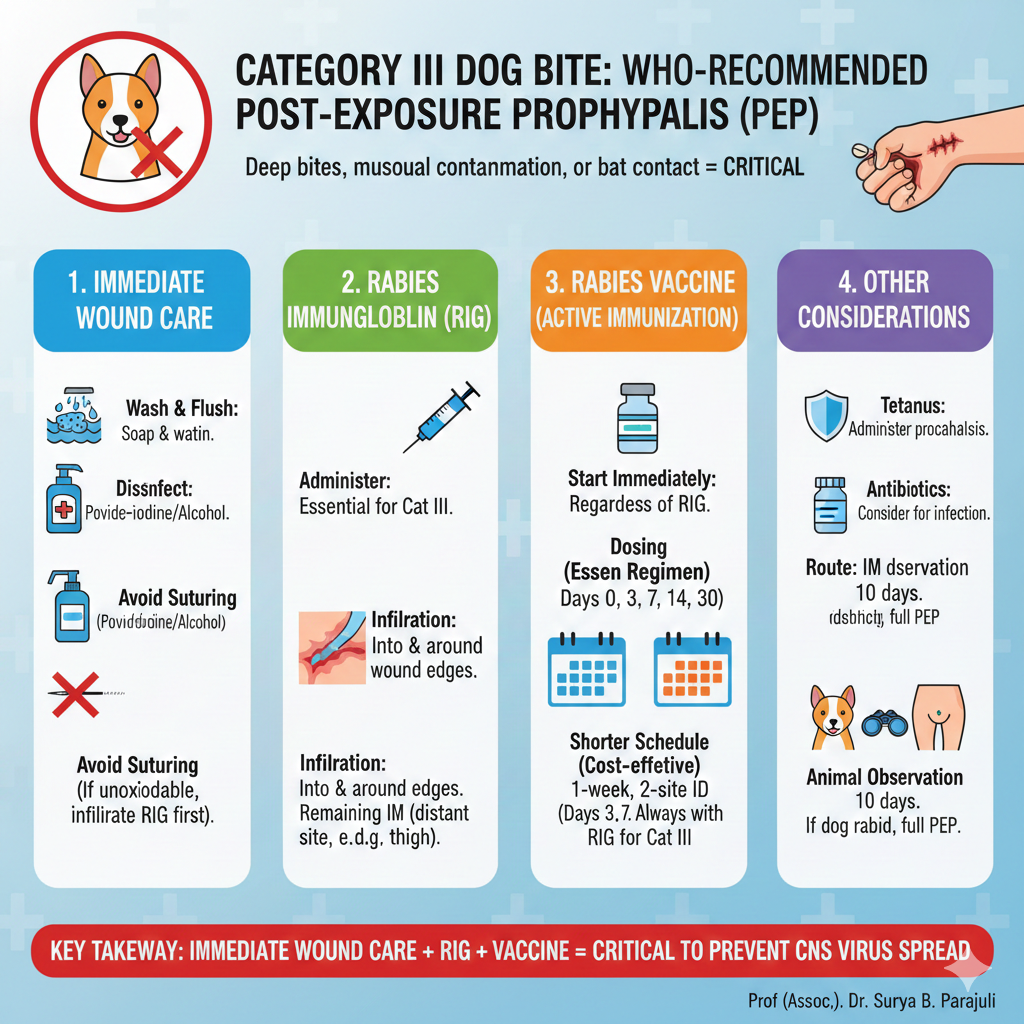
#a. WHO-recommended Post-Exposure Prophylaxis (PEP) (3 marks)
1. Immediate Wound Care (Crucial)
Wash & Flush: Immediately and thoroughly wash the wound with soap and water for at least 15 minutes.
Disinfect: Apply an antiseptic like povidone-iodine or alcohol to the wound.
Avoid Suturing: Do not suture bites if possible; if unavoidable, infiltrate RIG first and postpone suturing.
2. Rabies Immunoglobulin (RIG)
Administer: Essential for Category III exposures (deep bites, mucosal contamination, bat contact).
Infiltration: Infiltrate the recommended dose (e.g., 20 IU/kg) into and around the wound edges, using as much as anatomically feasible, with the remaining injected intramuscularly at a distant site (e.g., thigh).
3. Rabies Vaccine (Active Immunization)
Start Immediately: Begin vaccination as soon as possible, regardless of RIG.
Dosing (Essen Regimen): Typically 5 doses: Days 0, 3, 7, 14, 30.
Shorter Schedules: A 1-week, 2-site intradermal (ID) schedule (0.1mL on days 0, 3, 7) is also WHO-recommended for cost-effectiveness and compliance, but always used with RIG for Cat III.
Route: Intramuscular (IM) in the deltoid (or thigh for young kids) or Intradermal (ID).
4. Other Considerations
Tetanus: Administer tetanus prophylaxis.
Antibiotics: Consider antibiotics for wound infection prevention.
Animal Observation: Observe the dog for 10 days if possible; if it develops signs of rabies, the patient needs full PEP.
#b. Why modern cell culture vaccines are preferred over nerve tissue vaccines? (2 marks)
Safer
No risk of neuroparalytic complications (seen with nerve tissue vaccines)More effective
Higher and reliable antibody response
(Additional acceptable point: better tolerated, WHO-recommended)
#c. Advantages of intradermal (ID) rabies vaccination (2 marks)
Cost-effective
Uses smaller quantity of vaccineResource-saving
Allows vaccination of more people from one vial
Ideal for resource-limited settings like rural Nepal
#d. Role of “One Health Approach” in prevention and control of Rabies (3 marks)
One Health Approach
(Integration of Human health + Animal health + Environment)
Animal health measures
Mass dog vaccination
Control of stray dog population
Human health measures
Timely PEP
Awareness and health education
Intersectoral coordination
Collaboration between health, veterinary, municipal & environmental sectors
Surveillance and reporting of rabies cases