
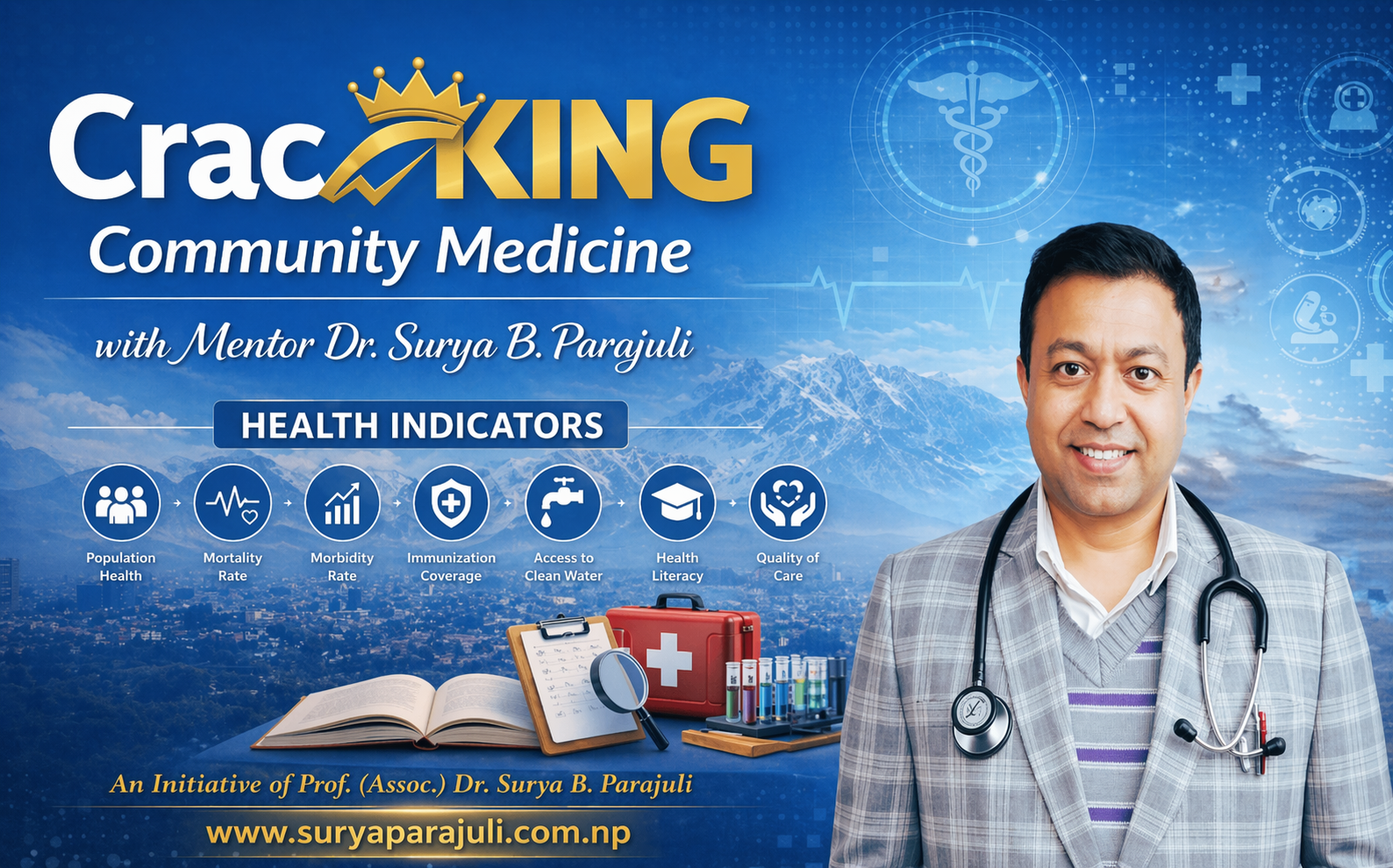

#Indicators of Health: Measuring Community Health in Numbers
By Prof. (Assoc.) Dr. Surya B. Parajuli
#🎯 Specific Learning Outcomes (SLOs)
At the end of this session, MBBS students should be able to:
Define and explain the concept of health indicators
Describe characteristics of an ideal health indicator
Classify different types of health indicators
Calculate and interpret IMR, MMR, incidence, and prevalence
Compare population health using indicators
Apply indicators in planning, monitoring, and evaluation of health programs
#🩺 Why MBBS Students Must Learn Health Indicators
Health indicators form the backbone of Community Medicine, Epidemiology, Public Health Planning, and National Health Programs.
#👨⚕️ Clinical Relevance
As future doctors, MBBS students must:
Understand disease burden in the community
Identify high-risk populations
Interpret national health statistics
Plan preventive strategies
Monitor health program success
Support evidence-based decision making
#📚 Academic Importance
This topic is:
Frequently asked in MBBS professional examinations
Common in MCQs, SAQs, and viva
Essential for research methodology
Important for postgraduate entrance exams
#🏥 Public Health Relevance
Doctors do not only treat patients—they improve community health.
For example:
High IMR → poor maternal-child services
High MMR → weak obstetric care
Low immunization → risk of outbreaks
High DALY → major chronic disease burden
Thus, learning indicators helps doctors move from:
#Individual patient care → Population health management
#📘 Introduction
Health is a multidimensional concept involving physical, mental, and social well-being. Since health cannot be measured directly, we use Health Indicators to convert health status into measurable numbers.
These indicators help us understand:
Disease burden
Death patterns
Nutritional status
Healthcare access
Social well-being
Environmental impact on health
Simply stated:
#“Health indicators convert health into numbers so we can understand, compare, and improve it.”
#🧾 Uses of Health Indicators
#📍 Major Uses
Measure community health status
Compare regions and populations
Identify priority health problems
Plan health services
Monitor and evaluate programs
Support health policy formulation
#⭐ Characteristics of an Ideal Indicator
#Essential Properties
#✅ Validity
Measures what it is supposed to measure
Example:
IMR reflects infant health status
#✅ Reliability
Gives consistent results repeatedly
#✅ Sensitivity
Detects small changes quickly
#✅ Specificity
Reflects only the intended condition
#✅ Feasibility
Easy to collect and calculate
#✅ Relevance
Useful for practical decision-making
#Important Concept
#No single indicator is perfect.
We use multiple indicators together for better understanding.
#📂 Classification of Health Indicators
#⚰️ A. Mortality Indicators
#Most Important Category
These are based on death statistics.
#1. Crude Death Rate (CDR)
#Formula
CDR = Total deaths in a year / Mid-year population × 1000
#Limitation
Affected by age structure of population
#2. Infant Mortality Rate (IMR) ⭐
#Formula
IMR = Deaths under 1 year / Live births × 1000
#Reflects
Maternal health
Nutrition
Immunization
Sanitation
Child healthcare quality
#Best single indicator of community health
#3. Maternal Mortality Ratio (MMR) ⭐
#Formula
MMR = Maternal deaths / Live births × 100000
#Indicates
Quality of obstetric care
Emergency obstetric services
Access to healthcare
#4. Under-5 Mortality Rate
#Better child health indicator than IMR
#5. Life Expectancy ⭐
#Average expected years of life
#Reflects
Socioeconomic development
Healthcare quality
Living conditions
#🤒 B. Morbidity Indicators
Measure frequency of disease
#1. Incidence Rate
#Formula
Incidence = New cases / Population at risk × 1000
#Shows
Risk of developing disease
#2. Prevalence Rate
#Formula
Prevalence = All existing cases / Total population × 1000
#Shows
Disease burden
#MCQ Favorite
#Incidence = New cases
#Prevalence = Total cases
#♿ C. Disability Indicators
#DALY (Disability Adjusted Life Year) ⭐
#Formula
DALY = YLL + YLD
#Combines
Mortality
Morbidity
#Used by
WHO
Global Burden of Disease studies
#🍽 D. Nutritional Indicators
Includes:
Height
Weight
BMI
Low birth weight
Clinical deficiency signs
#Reflects
Nutritional status of the population
#🏥 E. Healthcare Delivery Indicators
Measures resource availability
#Examples
Doctor-population ratio
Nurse-population ratio
Bed-population ratio
#📊 F. Utilization Indicators
Measures service use
#Examples
OPD attendance rate
Admission rate
Immunization coverage
#Reflects
Accessibility
Acceptance of services
#🧠 G. Social & Mental Health Indicators
#Examples
Suicide rate
Crime rate
Addiction rates
#Reflect
Mental and social well-being
#🌍 H. Environmental Indicators
#Examples
Air quality
Water quality
Sanitation coverage
Directly influence disease occurrence
#💰 I. Socioeconomic Indicators
#Examples
Literacy rate
Income
Employment
These are strong determinants of health
#📈 J. Composite Indicators
#1. PQLI
#Includes
IMR
Life expectancy
Literacy
#2. HDI ⭐
#Includes
Life expectancy
Education
Income
#Most widely used global indicator
#Key Public Health Indicators of Nepal
#👶 Infant Mortality Rate (IMR)
#28 deaths per 1,000 live births
This indicates the number of deaths of infants below one year of age per 1,000 live births. It is considered one of the best indicators of community health. According to the Nepal Demographic and Health Survey (NDHS) 2022, infant mortality declined from 78 in 1996 to 28 in 2022.
🔗 Reference: NDHS 2022 Key Indicators Report
#🤱 Maternal Mortality Ratio (MMR)
#151 maternal deaths per 100,000 live births
This reflects the quality of maternal and obstetric healthcare services. The Nepal Maternal Mortality Study 2021 reported the national MMR as 151 per 100,000 live births, with higher values in Lumbini and Karnali provinces.
🔗 Reference: Nepal Maternal Mortality Study 2021 Summary
#👧 Under-5 Mortality Rate
#33 deaths per 1,000 live births
This measures the probability of dying before the fifth birthday and reflects nutrition, immunization, and healthcare access. NDHS 2022 reported a decline from 118 in 1996 to 33 in 2022.
🔗 Reference: NDHS 2022 Child Mortality Data
#🎂 Life Expectancy at Birth
#70.35 years (2023)
Life expectancy reflects the overall health status, socioeconomic conditions, and healthcare quality of a nation. According to United Nations Population Division data, Nepal’s life expectancy reached 70.35 years in 2023.
🔗 Reference: Life Expectancy Data – Nepal
#💉 Full Immunization Coverage
#High national coverage (around 90%+)
Immunization coverage reflects the strength of primary healthcare services. NDHS 2022 and WHO reports show strong national immunization progress, contributing significantly to reduction in child mortality.
🔗 Reference: MOHP Nepal Health Reports
#📚 Literacy Rate
#Around 76%
Literacy is an important socioeconomic determinant of health and influences health awareness, maternal practices, and healthcare utilization.
🔗 Reference: Government of Nepal, National Statistics Office
#🚰 Access to Improved Drinking Water
#More than 90% of households
Safe drinking water is a major environmental health indicator that reduces diarrheal diseases and improves child survival.
🔗 Reference: WHO Nepal / UNICEF Nepal
#🏥 Institutional Delivery Rate
#More than 79%
Institutional delivery reflects access to skilled birth attendance and safe delivery services, directly contributing to reduced maternal mortality.
🔗 Reference: NDHS 2022 Maternal Care Section
#🔄 Application in Public Health
#Planning
Identify major health problems
#Monitoring
Track progress over time
#Evaluation
Assess program effectiveness
#Example
If IMR decreases:
#Maternal-child health programs are likely improving
#Final Take Home Message
#“What gets measured gets improved.”
Health indicators are not just exam topics—they are powerful tools for saving lives, improving systems, and strengthening nations.
For every future doctor: